
Writings:
What is writing?
15 Books



Poetry
Short stories
Vitrine: The Notebook Drawings
|
Looking
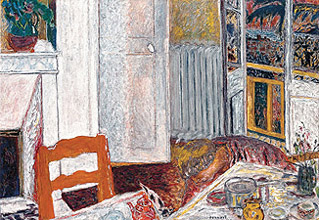
at 'The White Interior' by Pierre Bonnard, (1932) |
|
(His
voice) Is she feeding that dog again? It gets too much food- from
her. See how intent her face is, the concentration of it, its
strange grace. She is graced by tending to it. I shall growl like
a dog. Curse like a cur. Grunt, vomit up the days and hours and
months, all those long nights when I could hear her prowling,
hear the floorboards, even when her tread is so light, the slight
scratch of her heel. Sometimes I feel as if my mind were outside
my head, hovering near her, waiting to catch a sense of who she
really is. I am hovering so near her I feel as if I might have
eliminated space, that is the space you think keeps you to the
side of someone: so you're not inside but by them. I don't
feel that. I am right there, where she is. In her space. This
is what happens when I start to work. I don't know what
it could be called. I can't name it. It's a coming
to grips with what is there or what I want to be there. It's
as if I'm hatching something, maybe growing something, like
tending to seeds in the garden: one day there's nothing
there and then, when the rain and sun have been on them, there
is, new shoots which don't look like anything because they're
unformed, just surfacing. Not yet blemished by recognition. New.
Then there's a distinction between them and the rest of
the plants, things that have already grown. It helps to keep things discrete, I find. I like to keep my colours to themselves. It's a letting be, leaving what is there, coming through. Paying attention to it, to what it is at that moment of noticing it. Best not to talk about it. I'm not sure what I'd do if it didn't happen. Talking, now that is different. Dogs don't talk. It would not make much difference to me if I couldn't talk. Words aren't that useful. I thought they were at one time. And I have used them and sometimes used them quite well but what's the word for an open door, it's ajar! You see it's confusing. I like to keep things simple. She acts. I respond. No words. Just one act, then another, or more. It's a pattern I can adapt and work with. There's life in it. Her act triggers mine. I might trace lots of things, shape colours, draw sounds, dot. I like the way dots work on a page, especially next to lines and all the spaces that crop up. There it is again, this growing metaphor and maybe it is like a kind of rotation: dot, line, space, growing, heading towards the event of gleaning it. That blink of an eyeball. The dotting of a pen, the blob of it. The feel of the dot on the page. The rhythm of the black mark but I'm not drawing now. I'll paint this room, the lightness of it, just as she bends to the dog; everything as it is, the door, the radiator , the window , as always open, the table laid for dinner. It's just as it should be and ready to start. I always need to wait though because if you rush in too soon, it all goes wrong because you forget what you've seen. I always take my time, concentrate on nothing but where I am and where all the things in the room are too, where she is. She is always there somehow, when I work. It isn't as it is when we are alone because I am with my work, inside what I'm doing and she then is in it too. She might be out in the garden but for me she is more truly in my work. I see her better then. I can watch how she is in a new painting because she is never the same. I get in close, closer than you can ever imagine. I search her out. I prowl round the canvas, searching out each clue to what is there. Light is always somewhere and is always special. In this painting I light up her hair, it shimmers like gold, then I can see more shimmering on the wall, on the balcony, in the garden, on the mantelshelf. It has to be there because of all the white, the light moves into the picture plane and then the gold holds it down. I'm holding her head down too with this painting. It's not the dog. I'm not growling like a cur, I'm playing fine tunes with my brush, cadences of light and warmth and nearness and distance and inside and in the garden, it's all singing and it's my song: the lightness of it and the shadows, the door, the table, the radiator, the chair, the push and pull of surface plane and light, the fine lines of distinction between one part of the room and the next, it's all there, all lively. Nothing is still as it is in life. It is all energetic and pulsing with a kind of rhythm of one thing, then the next and the next. It's like a strong kite in the wind blowing out and tugging back, taking off, swerving round, diving to the ground. People might think that my paintings are still lives but they are not, they are lively as if they were alive and they are to me. They are life, not dead things hanging around as I do sometimes, waiting for her. In my pictures, it is all lively. I see it like a dance, a swirling and twisting and pirouetting, in and out and over and under, asking and responding and making things happen and most of all being happy. I yap like a dog when I work. I am busy, I am happy. I am attentive. I cherish my work and what I'm working on and what it shapes up. It always surprises, like the gold pot at the bottom edge almost off the table in this painting. How did that get there? She did not put it there. I did and I am happy with it. It sings to me. And that is how it is. I am lulled by it all until I think I might be finishing and then I fret, fret like an unfed cur, a chafe under the collar, raw and irritated. Then I get nervous and wait for something to ease me, for her to speak to me, for us to caress. I ache with fretfulness and my brushes start to work too quickly, dart here and there, clog the surface and dim the light on it. I will be forced to leave off and then the longing starts. Where is she? What is this? Will it last? What can I do now? I usually leave and walk in the garden but it haunts me, hounds me down the slope, shadows me as I take in the view. It is a darkness inside me which never leaves. Never gives up. Where is she now? I need to see her. |
| Looking at 'The White Interior' by Pierre Bonnard, (1932) |
CV Publications  Curation & Catalogue   Links |